
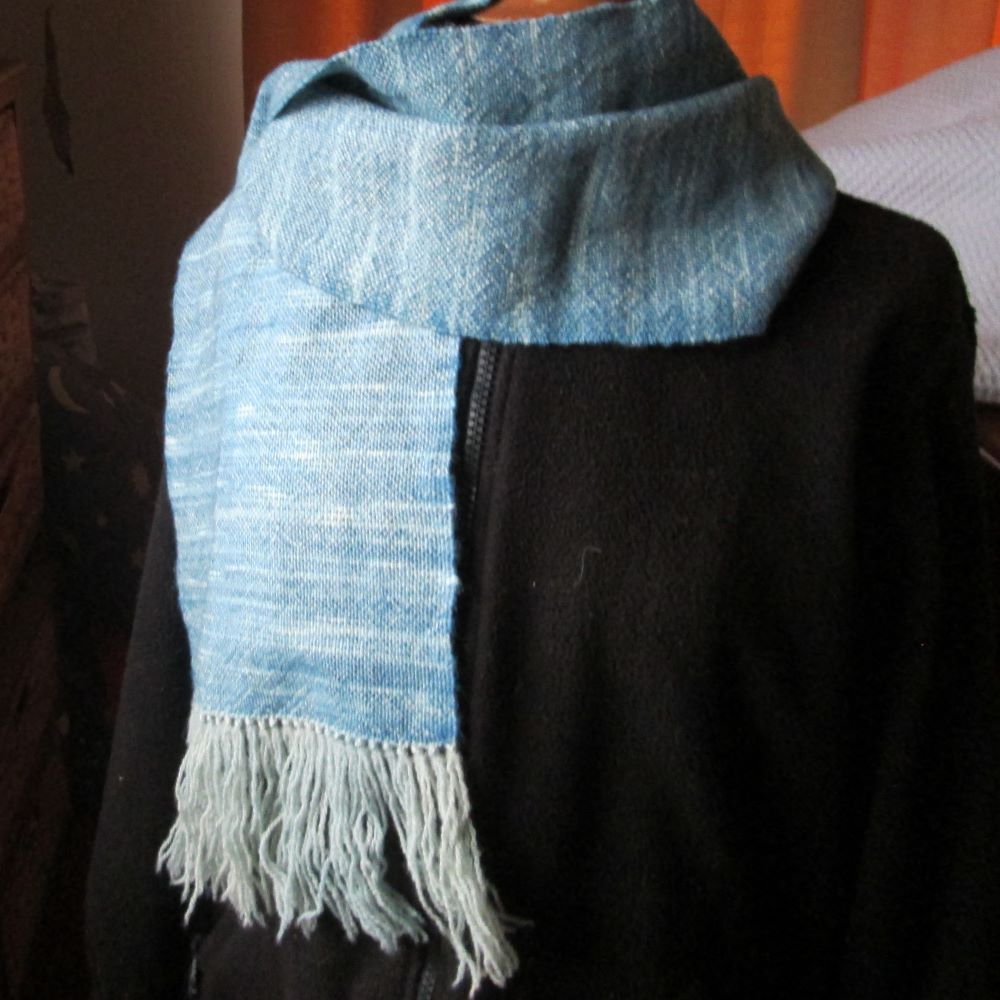
I really enjoy creating handwoven scarves. Partly because they are mostly a plain tabby weave, so very mindful to create, but also because of the design elements needed.
Many people will think that designing a scarf is easy, as it is simply a long piece of fabric. There are however many elements involved.
Choosing the Yarn
In some ways this is the hardest part, but also the easiest. I only use British wool from British sheep breeds. This narrows the selection down. I then need to think about the feel of the yarn. As a scarf is often in contact with the skin, it needs to be skin soft. This rules out the coarser breeds, like the Herdwick. Then there is availability. There is a lack of processing plants in the UK and low production of the soft fibre needed, making some yarns prohibitively expensive. I now always use Blue Face Leicester yarn. It is beautifully soft and has a lovely lustre (sheen).
The next consideration is the weight of the yarn. A chunky yarn results in a heavy, chunky scarf, which is great for winters in the Highlands, not quite so useful to wear as part of an everyday outfit. The finer yarns create a much lighter fabric with lovely drape, which looks great for everyday wear. Therefore, I use a 4-ply yarn, which is actually 2-ply when spun but the weight is called 4-ply based on the thickness of the yarn. Note this is also a great weight for knitting socks!
The Look and Feel
This is the fun part. What colour will I use? What pattern, if any? Does the scarf need to be tightly woven to create a more rigid structure or lightly woven, so it is light, drapey and soft. What will the ends look like?
I am a little limited with colour, as I only use 3 plant dyes that I grow at home, which produce 3 basic colours (yellow, reds and blue). The colours produced are, however, very variable so many options are available. I do need to make sure that I have enough yarn dyed in a particular colour for the scarf, as repeating a specific colour is not really possible.
The pattern is often plain in my case, although I do weave some checked pieces and play a bit more with the colour schemes. I think that a scarf can start to look a little busy though and that distracts from an outfit. Of course, it could be considered a statement piece, so maybe I need to play a bit more!
The next stage is deciding the epi (ends per inch) and ppi (picks per inch). This determines how tightly woven the finished scarf will be. The higher the epi and/or the ppi the tougher the fabric. I like a loose-ish drape and slightly open weave for my scarves, so I weave at an approximate sett of 12 epi and ppi. This is the woven sett. When you look at the finished scarf, it will appear to closer if you measure it. This is because the scarf is always finished after weaving and there will be some shrinkage.
The Finish
The final decision is to decide on how I want the ends to look. Sometimes I simply tie a knot and leave a fringe. Sometimes I twist the ends together after hemstitching the weft in place. The final, but more time consuming way is to weave all the ends back in, so there is no fringe at all. Personally, I struggle to decide, so if you want a custom-made scarf, the choice will be yours.
Now I just have to make the scarf itself!
You can always have a look at the ones I have already woven in the shop.
Leave a Reply