
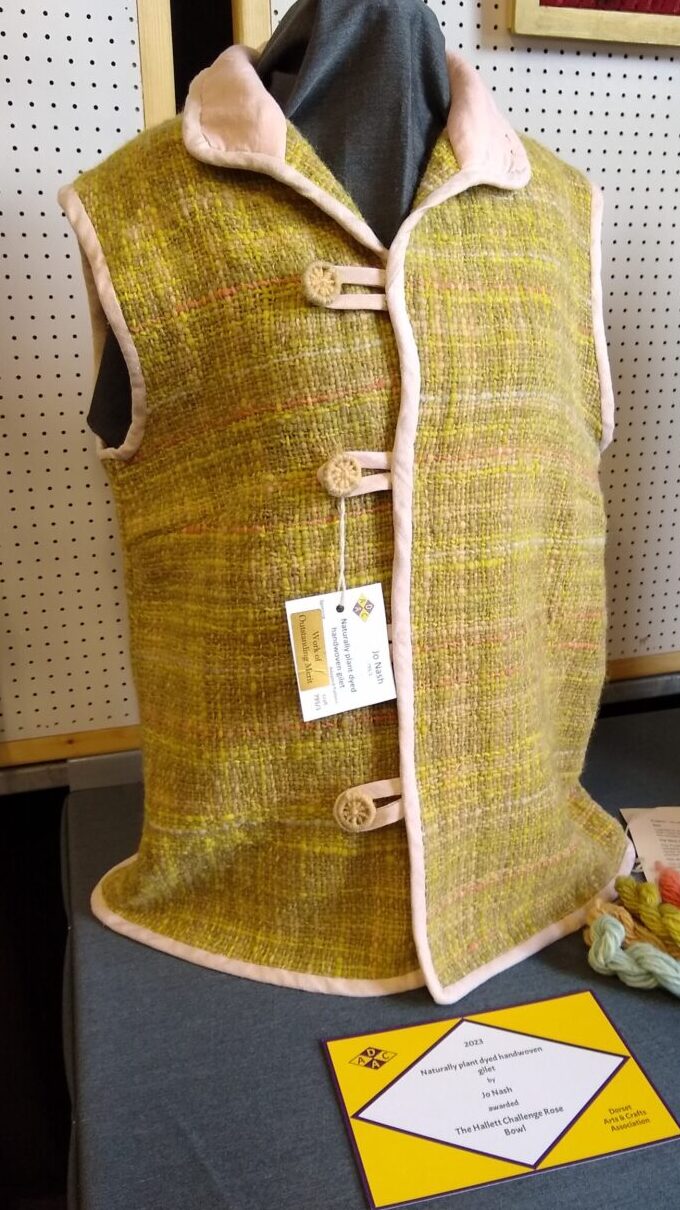
I wanted to create a gilet to wear at home and on seasonal walks from the sheep that I have bred. The fabric was to have texture and natural colours that reflected the verdant beauty of the Dorset countryside. So I set about achieving my aim!
The Sheep

First breed your sheep. I chose to breed Portland sheep over 15 years ago, because they are a local rare breed, They are also small, so easier to handle and good doers – they can look after themselves pretty well.
Portlands, generally, only produce single lambs. This makes lambing easier and mine lambed outside in the field. They were penned for a day or two post lambing to make sure everyone was OK, but with small numbers this was again relatively easy to achieve.
One of my aims was to improve the fleece of the Portland sheep, to make it more useable for hand spinning and further processing. Fortunately, there is a small group of people in Dorset who are also interested in producing better fleeces, without changing the characteristics of the breed fleece.
The Fibre and Yarn
Stage 2 is obtain your fibre for spinning. The Portland sheep were blade shorn by me. The fleece was sorted and washed in rainwater, to remove the dirt but leave in some lanolin. It was carded on a drum carder twice before being spun into thick singles. I didn’t aim for consistency as I wanted some texture to add interest to the fabric.

The Dyes

Next grow your dyes. I grow all my dye plants organically in my garden. I only use the “Ancient Three” plants. These are Woad, Weld and Madder. Evidence suggests that these plants have been used since the late Neolithic/ Early Bronze age. The colours were created from my homegrown organic plant dyes. Woad produced the blue, Madder the red and fawn and Weld the yellow and green.
The singles were either mordanted with Alum before dyeing with Madder or Weld or were fermentation dyed with Woad. Some of the yarn was then modified with iron to give the fawns (Madder) and greens (Weld) to produce the variegated colour. The skeins were washed and weighted to fix the twist.
Weaving the Fabric
The fabric was woven at 6epi and 6ppi on my 100 year old London school of weaving counterbalance four-shaft loom. It is plain tabby weave to bring out the colours and textures. The aim was for the colours to be random with the blue and red representing bursts of wildflower found in the countryside.

The cloth was washed in the washing machine. This is known as fulling. The fibres felt slightly, so the fabric becomes more stable and easier to cut up and sew.
The Gilet
The garment is based on the 800 vest pattern designed by Daryll Lancaster (The Weaver Sews). No attempt was made to colour match the pieces, to maintain the random nature of the colour design.
It is bound with bias cut linen, naturally dyed with Madder and sewn with green cotton thread.
Dorset Buttons
The finishing touch was adding Dorset cartwheel buttons. They were made using 1” hoops with some of the yarn, before I secured them with some of the wool yarn.
The Cup
Every year the Dorset Arts and Crafts Association have a Showcase event. As the name suggests it showcases many local craftworkers and artists. There is also a competition and one of the classes is for any hand spun article. Therefore I entered my gilet into this class and did no more than WON! Hence the cup!
So it isn’t just any gilet when I wear it in the Spring and Autumn, it’s a prize winning gilet!

Leave a Reply